
Intravitreal dexamethasone implant in epiretinal membrane-associated diabetic macular edema refractory to anti-VEGF therapy: a visual performance and retinal ultra-structural analysis
S. Nalcaci, H.H. Gobeka, K. Sincar, C. Akkin, F. Afrashi Department of Ophthalmology, Faculty of Medicine, Ege University, Izmir, Türkiye. email: hgobeka@gmail.com
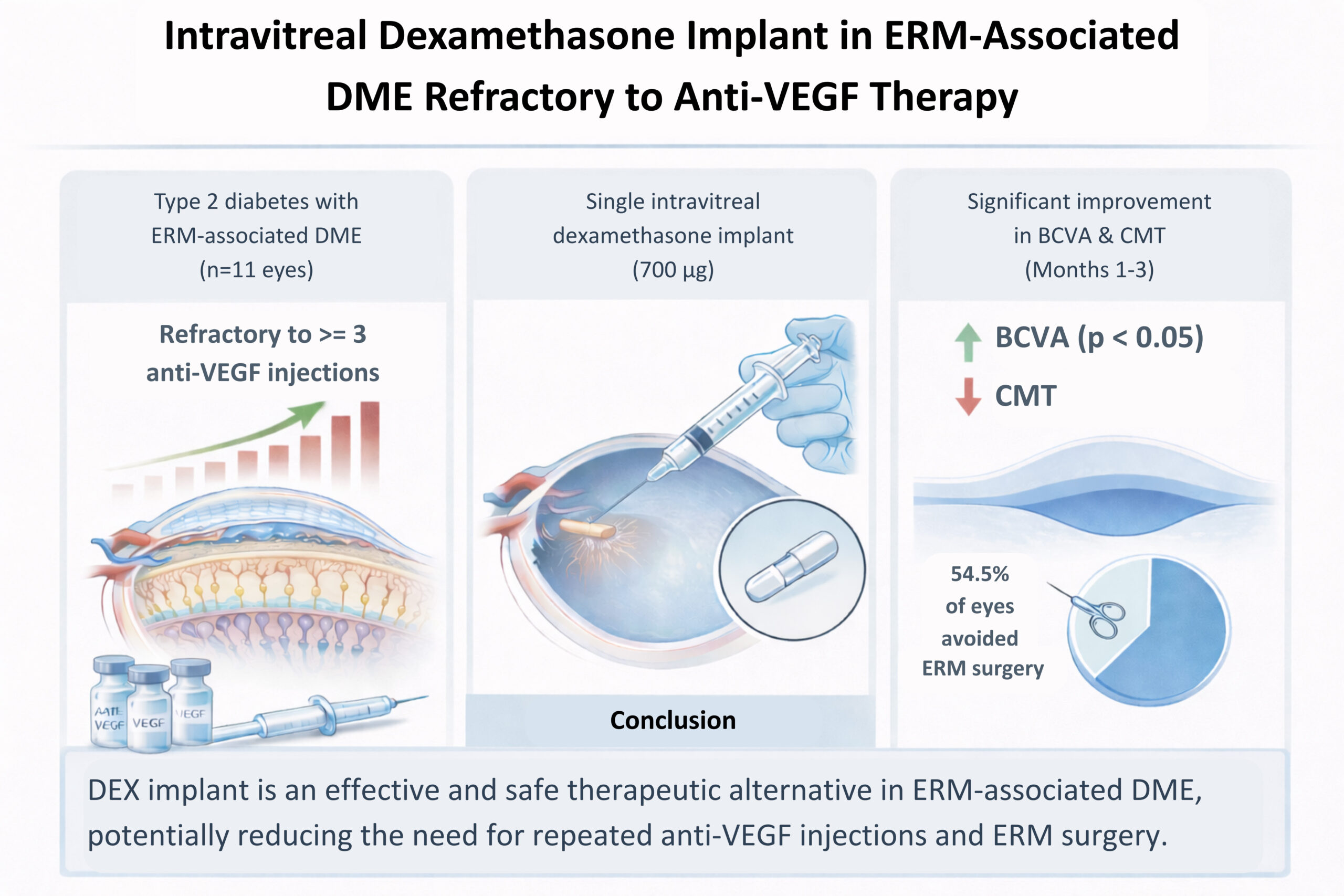
OBJECTIVE: The aim of the study was to report clinical outcomes of intravitreal dexamethasone (DEX) implant in patients with epiretinal membrane (ERM)-associated diabetic macular edema (DME) unresponsive to intravitreal ranibizumab (IVR).
MATERIALS AND METHODS: 11 eyes of type 2 diabetes patients >18 years old with ERM-associated DME unresponsive to ≥3 IVR injections were included. Patients with central macular thickness (CMT) >300 µm following a single dose DEX implant between January 2021 and December 2023, suggesting unresponsiveness or poor response, were retrospectively evaluated. A full ophthalmologic examination was performed pre- and first-to-sixth month post-therapy, including measuring best-corrected visual acuity (BCVA), intraocular pressure (IOP), and retinal ultra-structural parameters like CMT, central 1 mm retinal thickness (RT), and central macular volume (CMV).
RESULTS: The mean age was 66.50±5.01 years. BCVA increased considerably in the first two months (p<0.050) compared to pre-therapy. Changes in CMT, RT, and CMV were statistically significant for ≥4 months for CMT, five months for RT, and six months for CMV (p<0.050). Increased BCVA coincided with retinal ultra-structural healing throughout the same period. Most patients had predominantly normal IOPs. Anti-glaucoma medication was initiated in just three patients where IOPs were >25 mmHg.
CONCLUSIONS: DEX implant could be a reliable and effective therapeutic alternative for ERM-associated DME resistant to anti-VEGFs, particularly during the first 3 months of treatment, when it appears to be most effective. A single DEX implant can produce a satisfactory and reasonably safe response, and the treatment can be repeated even after the implant’s potency has gradually declined. Importantly, improved BCVA and retinal ultra-structure following DEX implant could lessen the need for ERM surgery and multiple intravitreal anti-VEGF injections. If ERM-associated DME persists despite multiple DEX implants, surgery should be considered.
Graphical Abstract

This work is licensed under a Creative Commons Attribution-NonCommercial-ShareAlike 4.0 International License
To cite this article
S. Nalcaci, H.H. Gobeka, K. Sincar, C. Akkin, F. Afrashi
Intravitreal dexamethasone implant in epiretinal membrane-associated diabetic macular edema refractory to anti-VEGF therapy: a visual performance and retinal ultra-structural analysis
Eur Rev Med Pharmacol Sci
Year: 2026
Vol. 30 - N. 2
Pages: 71-82
DOI: 10.26355/eurrev_202602_37689
Publication History
Submission date: 07 Jun 2025
Revised on: 20 Oct 2025
Accepted on: 01 May 2026
Published online: 27 Feb 2026