
Tissue-specific adaptive responses of the vitamin D3 auto-/paracrine system to vitamin D3 deficiency in bone and brain
I. Shymanskyi, O. Lisakovska, A. Khomenko, V. Bilous, Y. Kucheriavyi, I. Poladych, Y. Parkhomenko, M. Veliky Department of Biochemistry of Vitamins and Coenzymes, Palladin Institute of Biochemistry, National Academy of Sciences of Ukraine, Kyiv, Ukraine. ihorshym@gmail.com
OBJECTIVE: We hypothesized that vitamin D3 (VD3) coordinates a complex functional interplay between cerebral homeostasis and skeletal integrity by modulating mineral metabolism and osteotropic signaling. This neuroskeletal axis is likely mediated via a feedback loop involving fibroblast growth factor 23 (FGF23), a key regulator within both osseous and cerebral tissues. In this context, our study aimed to characterize tissue-specific adaptive responses by analyzing correlations between components of the vitamin D3 system and FGF23 signaling under physiological and VD3-deficient conditions.
MATERIALS AND METHODS: Twenty-four female Wistar rats were randomized into three experimental groups: intact (standard diet), VD3-deficient (vitamin-free diet), and repletion. The latter underwent an initial two-month depletion phase followed by one month of therapeutic VD3 supplementation (1,000 IU/kg b.w.). Serum 25(OH)D₃, PTH, and FGF23 levels (circulating and tissue-specific) were quantified via ELISA. The expression of the vitamin D3 receptor (VDR), vitamin D3-binding protein (VDBP), and hydroxylases CYP27B1 and CYP24A1 in cerebral and osseous lysates was determined via Western blotting.
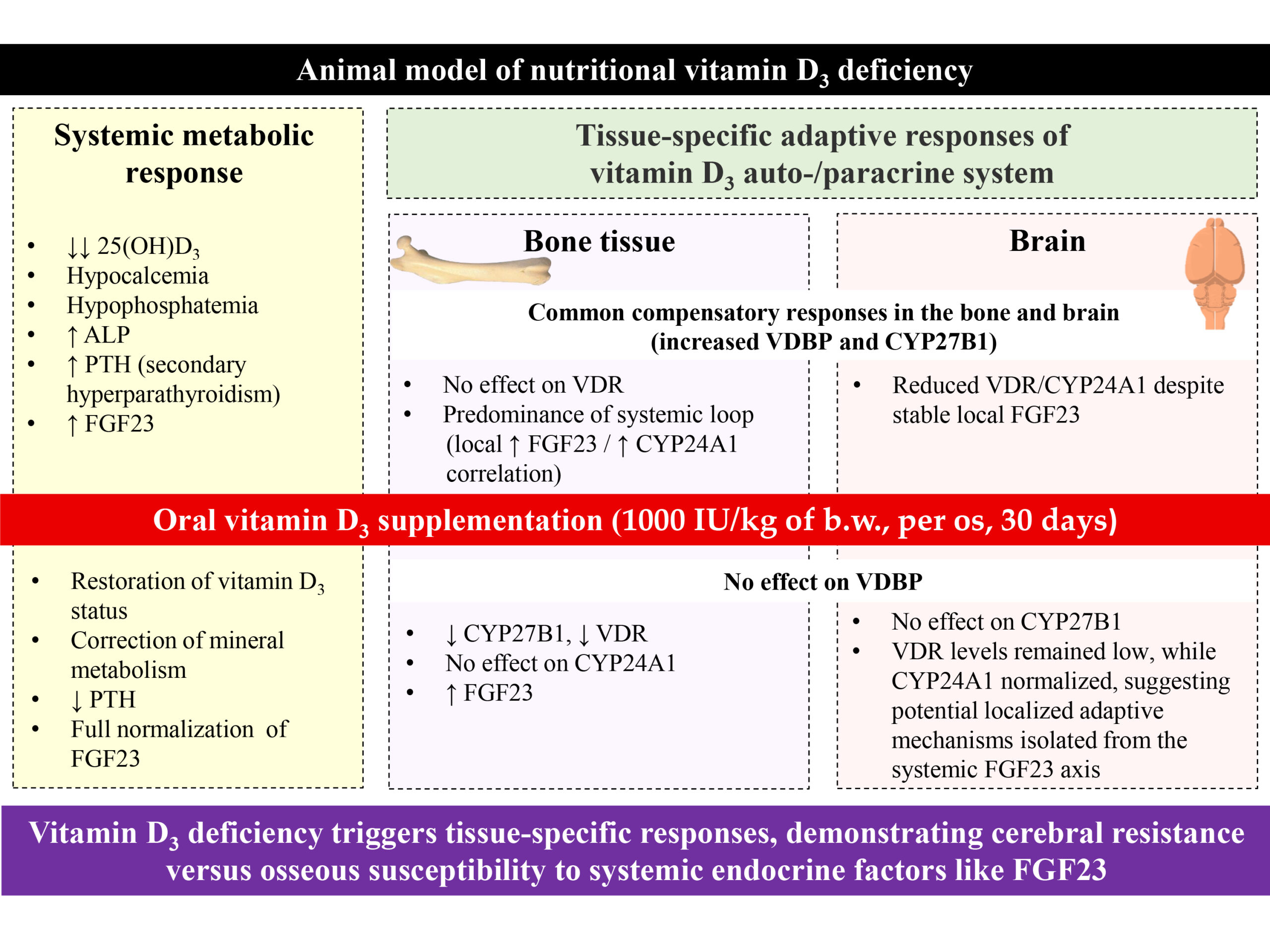
RESULTS: Dietary VD3 deficiency triggered systemic metabolic disturbances, including reduced serum 25(OH)D₃, hypocalcemia, secondary hyperparathyroidism, and elevated systemic FGF23. Tissue analysis revealed shared compensatory responses in both compartments, notably the induction of VDBP and CYP27B1. However, osseous regulation appeared to be dominated by systemic feedback loops (the FGF23/CYP24A1 correlation), whereas the brain exhibited distinct regulatory patterns, characterized by reduced VDR and CYP24A1 despite stable local FGF23 levels. Following VD3 replenishment, systemic and bone markers normalized, yet cerebral VDR levels remained persistently low.
CONCLUSIONS: VD3 deficiency triggers divergent, tissue-specific regulatory responses, suggesting that the brain may preserve a more stable internal environment than osseous tissue. These findings reflect a degree of cerebral metabolic regulation distinct from the systemic endocrine susceptibility driven by the FGF23 axis. However, the functional significance of these localized patterns and their underlying neuroprotective implications requires further comprehensive and robust experimental validation.
Graphical Abstract

This work is licensed under a Creative Commons Attribution-NonCommercial-ShareAlike 4.0 International License
To cite this article
I. Shymanskyi, O. Lisakovska, A. Khomenko, V. Bilous, Y. Kucheriavyi, I. Poladych, Y. Parkhomenko, M. Veliky
Tissue-specific adaptive responses of the vitamin D3 auto-/paracrine system to vitamin D3 deficiency in bone and brain
Eur Rev Med Pharmacol Sci
Year: 2026
Vol. 30 - N. 3
Pages: 113-125
DOI: 10.26355/eurrev_202603_37721
Publication History
Submission date: 17 Jan 2026
Revised on: 09 Feb 2026
Accepted on: 02 Mar 2026
Published online: 31 Mar 2026