
Development of a new diagnostic tool for detecting cervical cancer using a TCR-like antibody targeting the HPV 16 oncoprotein E7
R. Selva Rajan, S.A. Dass, B.A. Sachit, G.J. Tye, V. Balakrishnan Institute for Research in Molecular Medicine (INFORMM), University Sains Malaysia (USM), Penang, Malaysia. venugopal@usm.my
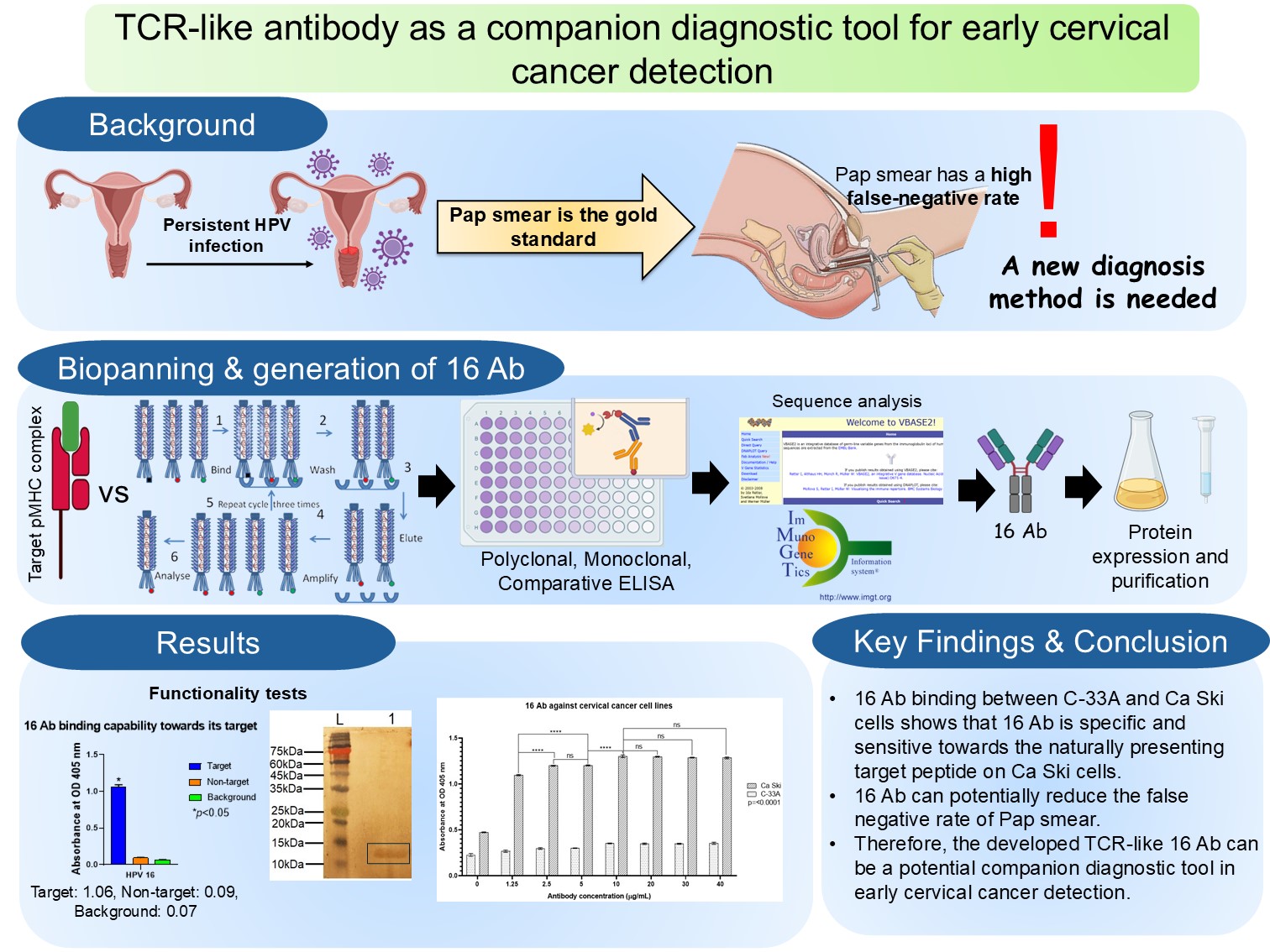
OBJECTIVE: Persistent Human Papillomavirus (HPV) infection causes 84% of cervical cancers (CC) worldwide. The current gold standard, Pap smear, has a high false-negative rate, highlighting the need for a specific and sensitive molecular method for early diagnosis. T cell receptor (TCR)-like antibodies offer a promising platform for cancer immunodiagnostics and immunotherapy.
MATERIALS AND METHODS: Using the phage display technique, a monoclonal TCR-like antibody (16 Ab) against HPV 16 oncoprotein E7 for human leukocyte antigen (HLA)-A2 was produced in this study. 16 Ab was selected from a single-domain antibody (sDAb) library via biopanning, an affinity-selection method. Once the clone of 16 Ab was selected, it was sequenced, and the result was analyzed using IMGT/V-Quest and VBase2 databases before proceeding with 16 Ab protein expression and purification. The purified 16 Ab was evaluated for its binding capability towards its target peptide-major histocompatibility complex (pMHC) by Western blot and Enzyme-Linked immunosorbent assay (ELISA).
RESULTS: A target pMHC complex was generated and panned against a phage display library. Highly enriched antibody phages from the 3rd biopanning round were chosen for phage ELISA analyses. Of the nine clones selected and sequenced, only two had proper sequences, and 16 Ab was chosen for the downstream process because it shows higher specificity for the target pMHC complex than the other clones. The dot blot showed that the soluble protein from 16 Ab was successfully expressed. The binding of 16 Ab towards the target pMHC complex (OD405 nm: 1.06) significantly differs from the non-target pMHC complex (OD405 nm: 0.09).
CONCLUSIONS: This study demonstrates the potential of 16 Ab as a companion diagnostic to reduce the rate of false-negative Pap smears. Further research is needed to assess its therapeutic potential, expand coverage to all HPV variants and HLA types, and evaluate its performance in cervical cancer cell lines before clinical testing.
Graphical Abstract

This work is licensed under a Creative Commons Attribution-NonCommercial-ShareAlike 4.0 International License
To cite this article
R. Selva Rajan, S.A. Dass, B.A. Sachit, G.J. Tye, V. Balakrishnan
Development of a new diagnostic tool for detecting cervical cancer using a TCR-like antibody targeting the HPV 16 oncoprotein E7
Eur Rev Med Pharmacol Sci
Year: 2026
Vol. 30 - N. 5
Pages: 164-180
DOI: 10.26355/eurrev_202605_37821
Publication History
Submission date: 14 Aug 2025
Revised on: 06 Oct 2026
Accepted on: 16 Feb 2026
Published online: 29 May 2026