
From models to medicine: advanced preclinical systems and AI enabling RNA therapeutics in triple-negative breast cancer
C. Esposito, I. Bello, E. Panza Department of Pharmacy, School of Medicine and Surgery, University of Naples Federico II, Naples, Italy. e.panza@unina.it
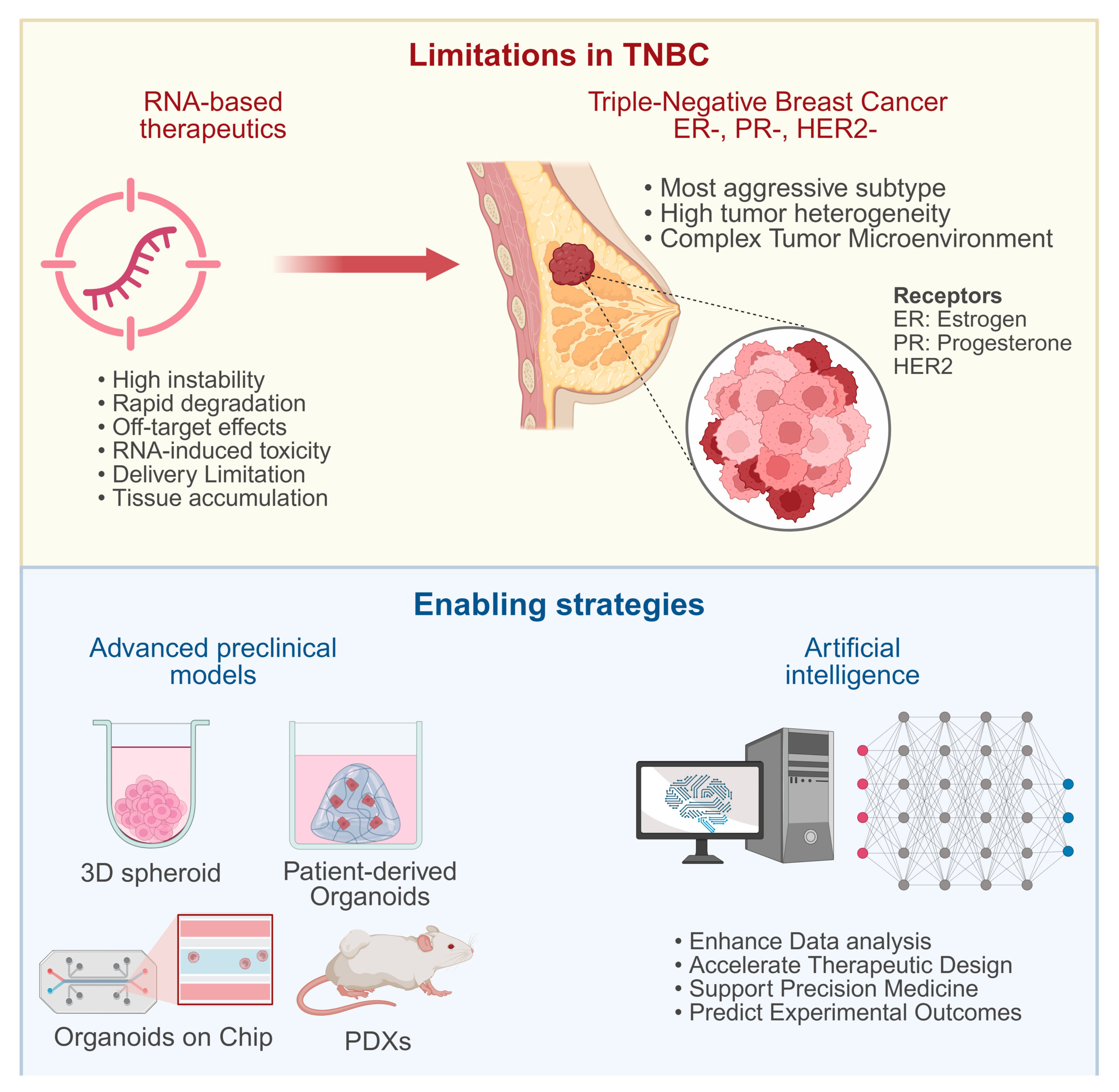
Triple-negative breast cancer (TNBC) is one of the most aggressive breast cancer subtypes, characterized by the lack of actionable molecular targets, pronounced intratumoral heterogeneity, and a highly dynamic tumor microenvironment (TME). RNA-based therapeutics, including messenger RNA (mRNA), small interfering RNA (siRNA), antisense oligonucleotides, and non-coding RNAs, represent a promising strategy for modulating gene expression and targeting previously undruggable pathways. Nevertheless, their clinical application in TNBC remains limited. This review aims to critically evaluate the main biological and technological barriers to RNA therapeutics in TNBC and to highlight emerging strategies to enhance their translational potential, with particular emphasis on advanced preclinical models and artificial intelligence (AI). The limited clinical success of RNA therapeutics in TNBC is primarily due to intrinsic RNA instability, rapid nuclease-mediated degradation, suboptimal and heterogeneous tumor delivery, and sequence-dependent off-target effects. Traditional two-dimensional in vitro models inadequately reproduce tumor architecture and TME complexity, resulting in poor predictive value. In contrast, advanced preclinical platforms-including three-dimensional spheroids, patient-derived organoids, organ-on-chip systems, and patient-derived xenografts-better recapitulate tumor biology, cell-microenvironment interactions, and interpatient variability. Concurrently, AI and machine learning approaches are increasingly employed to optimize RNA sequence design, predict off-target effects, improve nanoparticle-based delivery systems, integrate multi-omics and spatial transcriptomics data, and support patient stratification. The integration of physiologically relevant preclinical models with AI-driven approaches represents a promising strategy to overcome current limitations in RNA-based therapeutics for TNBC. This multidisciplinary framework may enhance delivery efficiency, reduce attrition rates, and accelerate the development of RNA-based precision oncology strategies in TNBC.
Graphical Abstract

This work is licensed under a Creative Commons Attribution-NonCommercial-ShareAlike 4.0 International License
To cite this article
C. Esposito, I. Bello, E. Panza
From models to medicine: advanced preclinical systems and AI enabling RNA therapeutics in triple-negative breast cancer
Eur Rev Med Pharmacol Sci
Year: 2026
Vol. 30 - N. 6
Pages: 214-228
DOI: 10.26355/eurrev_202606_37857
Publication History
Submission date: 15 Apr 2026
Revised on: 27 Apr 2026
Accepted on: 05 Jun 2026
Published online: 30 Jun 2026