
Double vs. triple antithrombotic therapy: a meta-analysis of the real-life effect in about 20,000 patients with atrial fibrillation undergoing coronary artery stenting
M.C. Acconcia, Q. Caretta, F. Chiarotti, G. Pannarale, G. Tanzilli Department of Clinical, Internal Medicine, Anesthesiological and Cardiovascular Sciences, “Sapienza” University of Rome, Rome, Italy. qcaretta@gmail.com
OBJECTIVE: The aim of the present meta-analysis is to assess and quantify the effectiveness in the current clinical practice of double antithrombotic therapy (DAT) vs. triple antithrombotic treatment (TAT) regimens in patients affected by atrial fibrillation undergoing coronary artery stenting, complementing findings based on randomized clinical trials (RCT) with those based on observational studies and registries.
MATERIALS AND METHODS: Sixteen observational studies were retrieved through the PubMed database. Risk ratio (RR) and absolute risk reduction (RD) with 95% confidence interval, together with the number needed to treat (NNT), were computed to compare the examined endpoints (mortality, major bleeding, intracranial hemorrhage, stroke, and stent thrombosis).
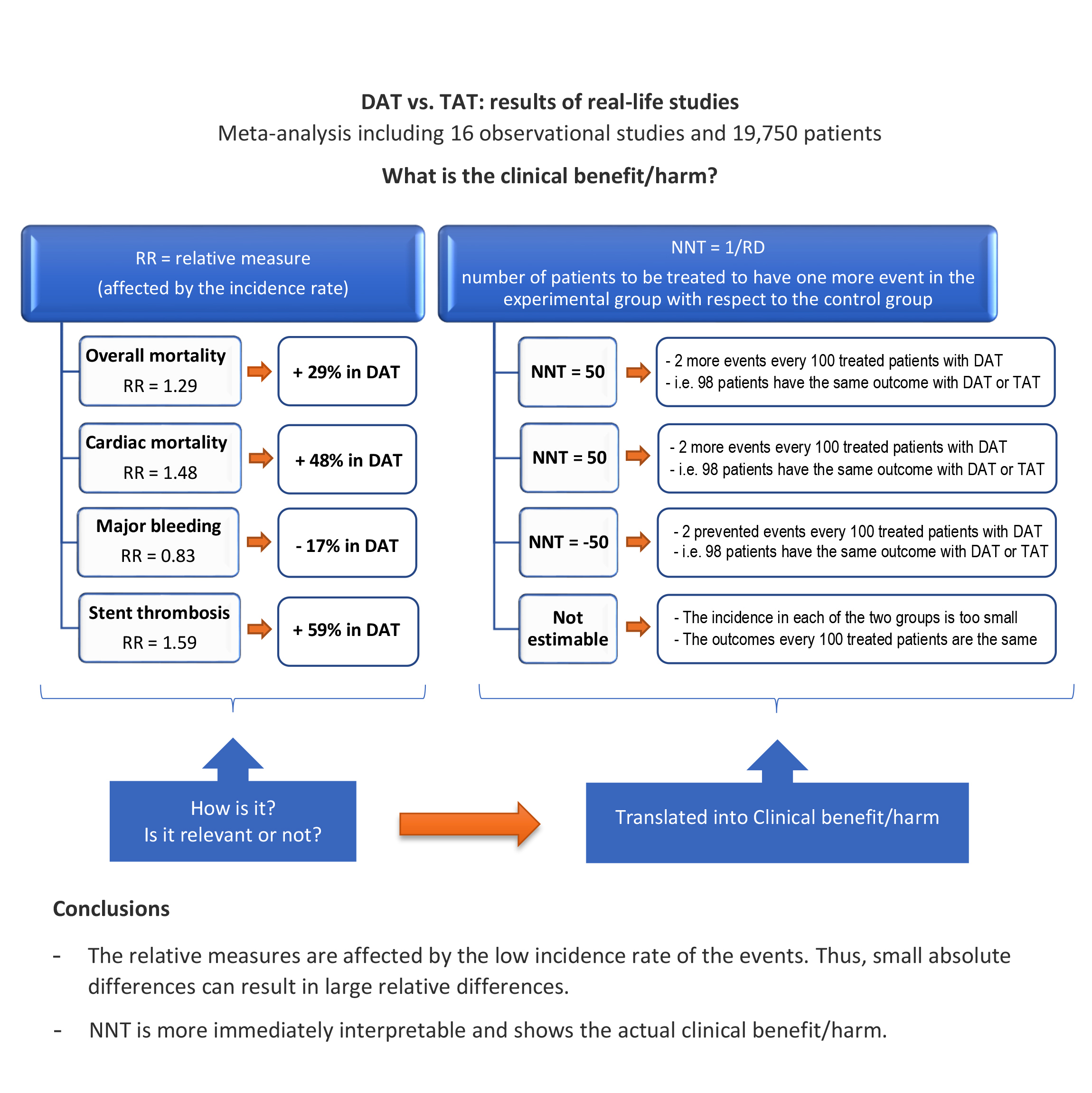
RESULTS: The meta-analysis on RR in DAT in comparison to TAT demonstrated a significant reduction in bleeding risk, as expected. On the contrary, a significant increase in the risk of overall and cardiovascular death and of stent thrombosis was shown.
The RD and the derived NNT ruled out that, due to the lower incidence of the events, the real benefit of DAT vs. TAT was a reduction of 2 major bleeding cases every 100 treated patients. On the contrary, the overall and cardiovascular mortality was increased in DAT, with two more deaths every 100 treated patients.
CONCLUSIONS: Our meta-analysis demonstrates that, to be appropriate for use in clinical practice, guidelines must be based on solid scientific evidence from RCTs, complemented by observational studies that better represent real-world patients and treatment adherence. Furthermore, in case of rare events, RR can amplify the size of an effect that is clinically not relevant. Efficacy measures that take into account the low incidence of the event, such as RD and NNT, are desirable. Furthermore, the NNT allows for the direct quantification of the number of patients who benefit or suffer harm from the study treatment and should therefore be preferred.
Graphical Abstract

This work is licensed under a Creative Commons Attribution-NonCommercial-ShareAlike 4.0 International License
To cite this article
M.C. Acconcia, Q. Caretta, F. Chiarotti, G. Pannarale, G. Tanzilli
Double vs. triple antithrombotic therapy: a meta-analysis of the real-life effect in about 20,000 patients with atrial fibrillation undergoing coronary artery stenting
Eur Rev Med Pharmacol Sci
Year: 2025
Vol. 29 - N. 12
Pages: 563-577
DOI: 10.26355/eurrev_202512_37566
Publication History
Submission date: 22 Aug 2025
Revised on: 14 Oct 2025
Accepted on: 23 Oct 2025
Published online: 23 Dec 2025