
Cross-linked carboxymethyl cellulose and silk proteins for dry eye disease management and corneal wound healing: in vivo and in vitro results
F. Scarinci, G. De Simone, G. Coco, C. Caggiano, G. Pocobelli, F. Boselli, A. Di Masi Department of Ophthalmology, San Giovanni-Addolorata Hospital, Rome, Italy. scarincifa@gmail.com
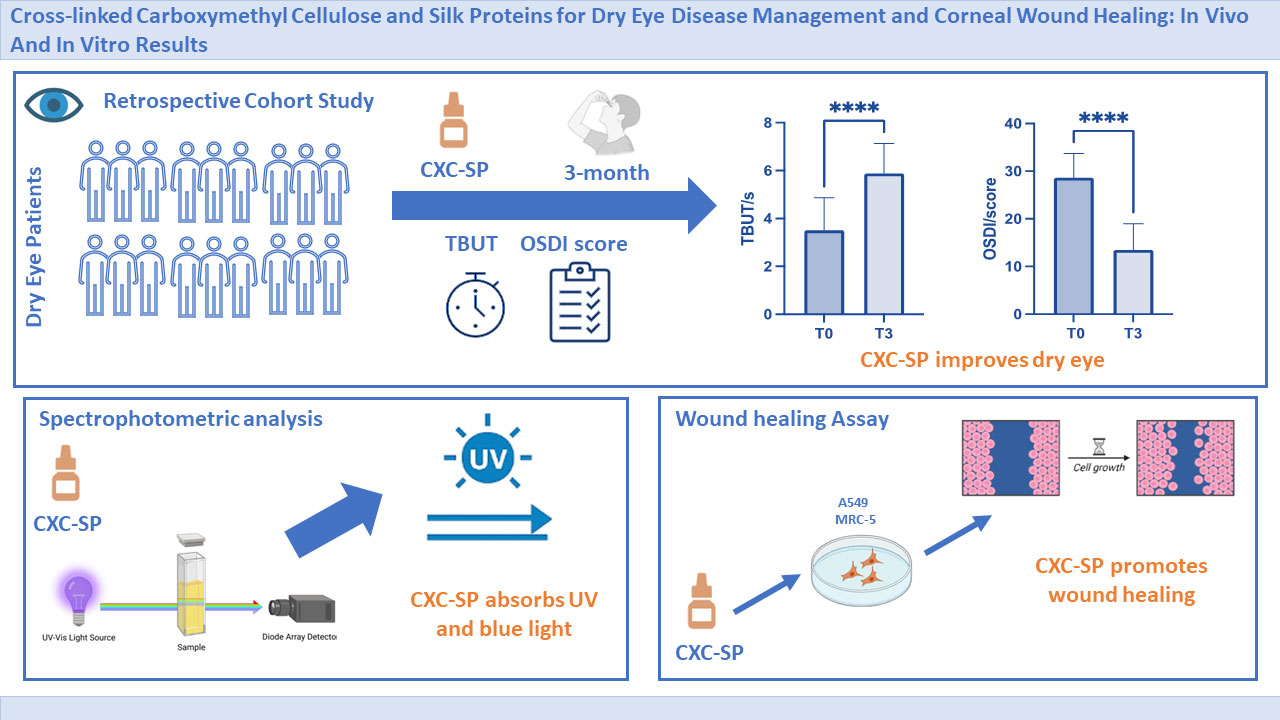
OBJECTIVE: This retrospective cohort study aims to uncover the potential clinical effectiveness of a novel ophthalmic solution containing cross-linked carboxymethyl cellulose (CX-CMC) and silk proteins (SP) in dry eye disease, evaluating its efficacy in improving Tear Breakup Time (TBUT) and Ocular Surface Disease Index (OSDI) over a 3-months treatment and in absorbing ultraviolet (UV) and blue light and promoting wound healing.
MATERIALS AND METHODS: Two different populations were retrieved from the database; the first group consisted of 20 dry-eye patients who underwent a 3-month treatment with an ophthalmic solution containing CX-CMC and SP. The second group was composed of 10 dry-eye patients who did not want to use any eye lubricant or other treatment. The outcome measures, TBUT and OSDI, were analyzed before (T0) and after (T3) treatment. In addition, the ophthalmic solution was investigated for its capacity to absorb UV and blue light and to promote wound healing. Specifically, UV and blue absorbance were tested by means of a UV-VIS spectrophotometer, while the wound healing test was conducted using two distinct cell lines to assess the efficacy of the solution in facilitating cicatrization.
RESULTS: The ophthalmic solution effectively restored tear film stability, as evidenced by the improved TBUT values and reduced dry eye disease symptoms evaluated through the OSDI score. Furthermore, it demonstrated absorption capabilities within the UV and blue wavelength range. In terms of wound recovery, the ophthalmic solution supported cell motility compared to untreated cells.
CONCLUSIONS: The ophthalmic solution containing CX-CMC and SP was effective in improving dry-eye signs and symptoms in patients and in absorbing UV and blue light. Furthermore, the ophthalmic solution promoted wound healing in vitro. Collectively, the results suggest that CX-CMC and SP eye drops could serve as a promising tool for treating dry eye disease of various origins.
Graphical Abstract

This work is licensed under a Creative Commons Attribution-NonCommercial-ShareAlike 4.0 International License
To cite this article
F. Scarinci, G. De Simone, G. Coco, C. Caggiano, G. Pocobelli, F. Boselli, A. Di Masi
Cross-linked carboxymethyl cellulose and silk proteins for dry eye disease management and corneal wound healing: in vivo and in vitro results
Eur Rev Med Pharmacol Sci
Year: 2026
Vol. 30 - N. 2
Pages: 62-70
DOI: 10.26355/eurrev_202602_37688
Publication History
Submission date: 08 Aug 2025
Revised on: 23 Oct 2025
Accepted on: 05 Dec 2025
Published online: 27 Feb 2026