
Chloroprocaine vs. prilocaine for spinal anesthesia in outpatient knee arthroscopy: a prospective economic evaluation using activity-based costing
C. Franceschi, F. Tasso, V. Simili, G. Monteleone, F. Martorelli, A. De Angelis, E. Cialdella, D. Esposito, G. Anzillotti, P. Conte, B. Di Matteo, E. Kon, M. Scardino IRCCS Humanitas Research Hospital, Rozzano, Milan, Italy. carlotta.franceschi@humanitas.it
OBJECTIVE: In orthopedic day-hospital interventions like knee arthroscopy, the choice of the short-acting local anesthetic to be used for spinal anesthesia may significantly impact both recovery times and hospital-related costs.
MATERIALS AND METHODS: This prospective, two-arm cohort study included 70 adult patients undergoing an elective knee arthroscopy for meniscectomy who received either spinal chloroprocaine (40 mg, 1%) or prilocaine (40 mg, 2%). Cost analysis was performed using an activity-based costing approach, whereby resource utilization was multiplied by corresponding unit tariffs and summed across the following cost domains: operating room time, recovery room time, nurse care time, physician (anesthesiologist) care time, drug and device usage, and any unplanned overnight hospitalization. The primary outcome was the mean procedure cost per patient; secondary outcomes included perioperative time metrics and adverse events.
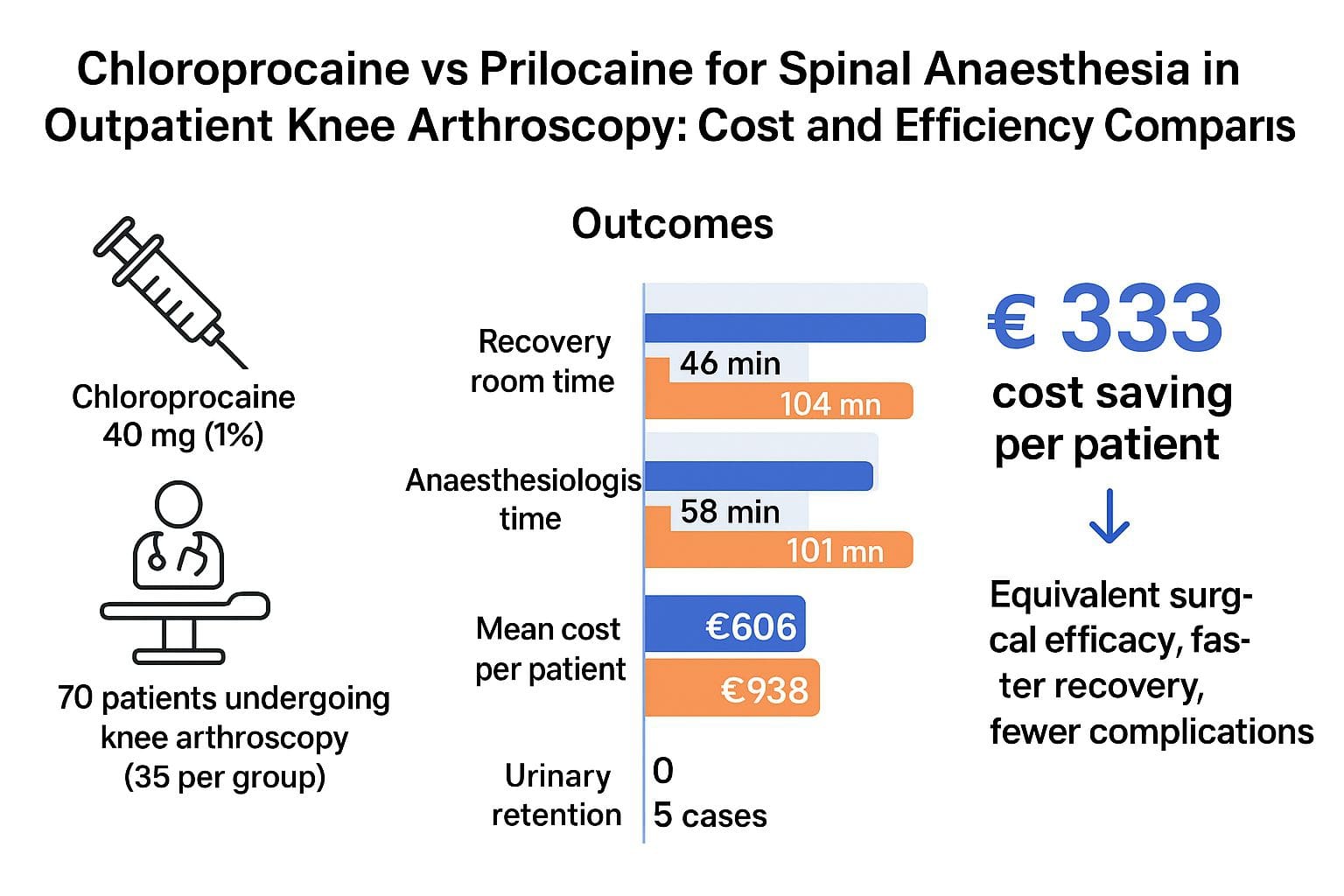
RESULTS: Seventy subjects were recruited and assigned to one of the two groups, each consisting of 35 patients. The mean cost of the procedure per patient was €604.76 in the chloroprocaine group vs. €938.09 in the prilocaine group (difference = €333.33). Recovery room time and physician (anesthesiologist) care time were significantly shorter in the chloroprocaine group compared to the prilocaine group (45.63 vs. 104.00 minutes and 57.86 vs. 100.57 minutes, respectively, both p-values < 0.001). Urinary retention occurred in five patients in the prilocaine group, compared to none in the chloroprocaine group. One patient in the prilocaine group required overnight hospitalization.
CONCLUSIONS: The use of chloroprocaine for spinal anesthesia was associated with significantly shorter perioperative care times and lower hospital-related costs compared to prilocaine. Nonetheless, further high-quality, multicenter randomized controlled trials are needed to confirm the pharmacoeconomic advantages of using chloroprocaine for cost-effective spinal anesthesia.
Graphical Abstract

This work is licensed under a Creative Commons Attribution-NonCommercial-ShareAlike 4.0 International License
To cite this article
C. Franceschi, F. Tasso, V. Simili, G. Monteleone, F. Martorelli, A. De Angelis, E. Cialdella, D. Esposito, G. Anzillotti, P. Conte, B. Di Matteo, E. Kon, M. Scardino
Chloroprocaine vs. prilocaine for spinal anesthesia in outpatient knee arthroscopy: a prospective economic evaluation using activity-based costing
Eur Rev Med Pharmacol Sci
Year: 2026
Vol. 30 - N. 2
Pages: 83-90
DOI: 10.26355/eurrev_202602_37690
Publication History
Submission date: 05 Nov 2025
Revised on: 08 Jan 2026
Accepted on: 15 Jan 2026
Published online: 27 Feb 2026