
Evaluation of the impact of post-emergency visit on diagnostic and therapeutic changes in orthopedics
A. Laudat, T. Stoclet, N. Kloek, M. Leplomb, L.-M. Joly, M. Taalba, M. Lalevée Orthopedic and Trauma Surgery Department, Rouen University Hospital, Rouen, France. aldtapple@gmail.com
OBJECTIVE: Musculoskeletal trauma accounts for more than a third of emergency department visits, and accurate diagnosis and treatment can be challenging in the acute setting. The objective of our study was to evaluate the impact of a post-emergency orthopedic visit on diagnostic and therapeutic changes in patients with minor trauma.
MATERIALS AND METHODS: We conducted a prospective observational study in two French university hospitals. Adult patients referred to a post-emergency orthopedic visit for minor upper or lower limb trauma were included. Exclusion criteria included immediate surgical indication or injuries outside the limbs. Data collected during both initial and follow-up visits were compared to identify diagnostic changes (DCs) and therapeutic modifications (TMs), with TMs classified as resulting in either more or less intensive care.
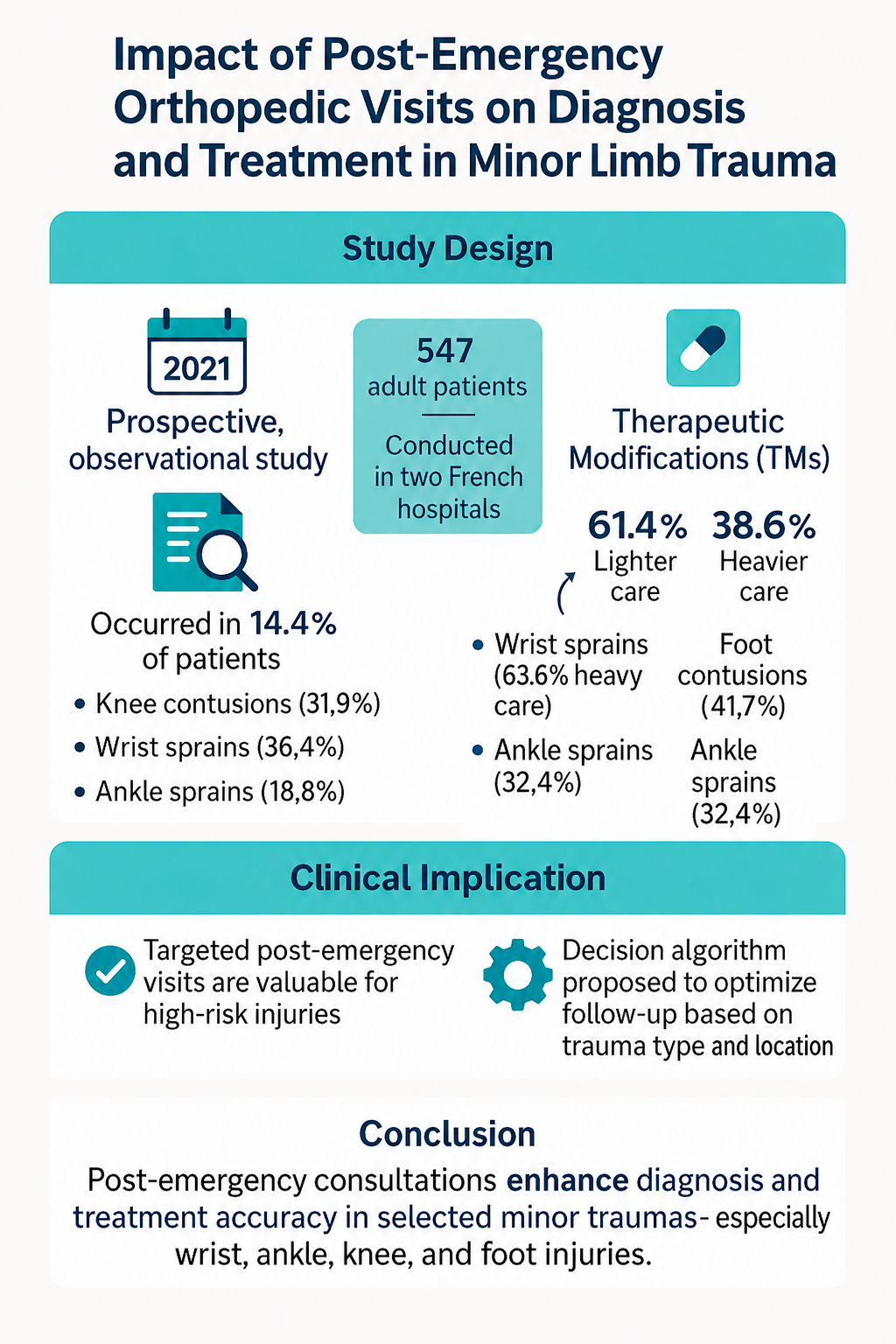
RESULTS: A total of 547 patients were included. DCs occurred in 14.4% patients (n=79), and TMs were made in 23.2% (n=127). Among patients with TMs, 61.4% (n=78) received less intensive treatment, while 38.6% (n=49) required more intensive care. The highest rates of DCs were observed for knee contusions (31.9%, n=15/47), wrist sprains (36.4%, n=4/11), and ankle sprains (18.8%, n=12/64). TMs leading to less intensive care were most frequently noted in ankle sprains (21.9%, n=14/64), knee contusions (21.3%, n=10/47), foot fractures (11.3%, n=7/62), and wrist fractures (10.6%, n=9/85). More intensive care was frequently required for wrist sprains (63.6%, n=7/11) and foot contusions (25%, n=3/12). Injuries such as shoulder dislocations (TM: 0%) and shoulder fractures (DC: 6.9%, TM: 10.3%) rarely led to modifications during the post-emergency visit.
CONCLUSIONS: The post-emergency visit is of interest when targeting trauma pathologies at risk of diagnostic change or therapeutic modification.
Graphical Abstract

This work is licensed under a Creative Commons Attribution-NonCommercial-ShareAlike 4.0 International License
To cite this article
A. Laudat, T. Stoclet, N. Kloek, M. Leplomb, L.-M. Joly, M. Taalba, M. Lalevée
Evaluation of the impact of post-emergency visit on diagnostic and therapeutic changes in orthopedics
Eur Rev Med Pharmacol Sci
Year: 2026
Vol. 30 - N. 4
Pages: 143-151
DOI: 10.26355/eurrev_202604_37752
Publication History
Submission date: 01 May 2025
Revised on: 20 Jun 2025
Accepted on: 08 Apr 2026
Published online: 30 Apr 2026