
Predictive value of the triglyceride-glucose index combined with novel body shape indices for cardiovascular disease: a cross-sectional study based on NHANES
Y. Zheng, Q. Li Hebei North University, Hebei, China. liquanwwwwjjjj@163.com
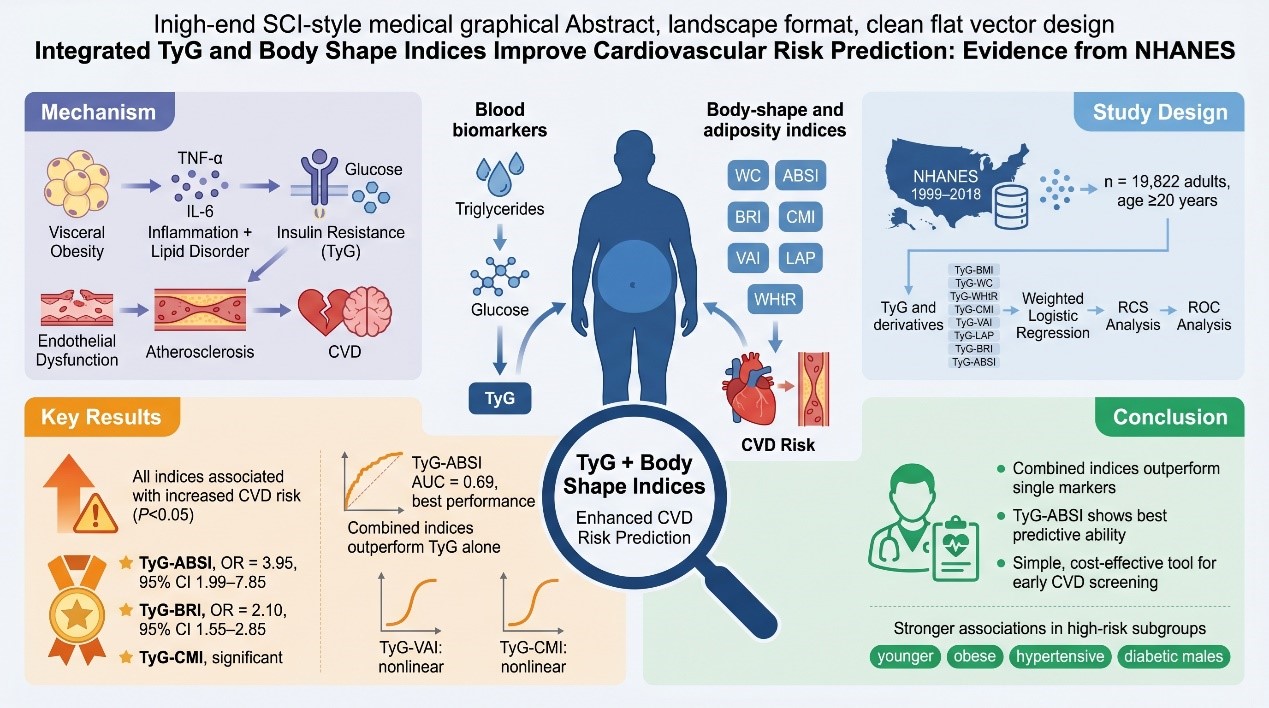
OBJECTIVE: Cardiovascular disease (CVD) remains one of the leading causes of death worldwide. Insulin resistance (IR) and central obesity are key contributors. The triglyceride–glucose (TyG) index is a simple surrogate for IR, while novel adiposity indices, such as the visceral adiposity index (VAI), lipid accumulation product (LAP), cardiometabolic index (CMI), body roundness index (BRI), and a body shape index (ABSI), better reflect body fat distribution. However, the predictive value of combining TyG with these indices for CVD risk remains unclear.
MATERIALS AND METHODS: This cross-sectional study used data from 19,822 adults aged ≥20 years in the U.S. NHANES (1999-2018). CVD was defined by self-reported physician diagnosis. The TyG index and its derivatives (TyG-BMI, TyG-WC, TyG-WHtR, TyG-CMI, TyG-VAI, TyG-LAP, TyG-BRI, TyG-ABSI) were calculated. Weighted logistic regression and restricted cubic spline (RCS) analyses assessed associations and potential nonlinear relationships. Receiver operating characteristic (ROC) curves compared predictive performance.
RESULTS: All TyG-derived indices were significantly associated with higher CVD risk (p<0.05). The strongest associations were observed for TyG-ABSI (OR=3.95, 95% CI: 1.99-7.85) and TyG-BRI (OR=2.10, 95% CI: 1.55-2.85). TyG-VAI and TyG-CMI showed nonlinear relationships with CVD. In ROC analysis, TyG-ABSI achieved the highest discriminative power (AUC=0.69), outperforming TyG and other indices. Subgroup analyses revealed stronger associations among younger, obese, hypertensive, and diabetic males.
CONCLUSIONS: Combining the TyG index with body-shape indices markedly improved CVD risk prediction. TyG-ABSI, TyG-BRI, and TyG-CMI showed superior diagnostic performance and may serve as cost-effective tools for early CVD risk assessment in clinical and public health settings.
Graphical Abstract

This work is licensed under a Creative Commons Attribution-NonCommercial-ShareAlike 4.0 International License
To cite this article
Y. Zheng, Q. Li
Predictive value of the triglyceride-glucose index combined with novel body shape indices for cardiovascular disease: a cross-sectional study based on NHANES
Eur Rev Med Pharmacol Sci
Year: 2026
Vol. 30 - N. 9
Pages: 344-355
DOI: 10.26355/eurrev_202609_37975
Publication History
Submission date: 26 Oct 2025
Revised on: 24 Nov 2025
Accepted on: 08 Sep 2026
Published online: 30 Sep 2026