
Pioglitazone ameliorates doxorubicin-induced hypothyroidism and cardiotoxicity in rat models
A.H. Alhowail Department of Pharmacology and Toxicology, College of Pharmacy, Qassim University, Buraydah, Al Qassim, Saudi Arabia. aalhowail@qu.edu.sa
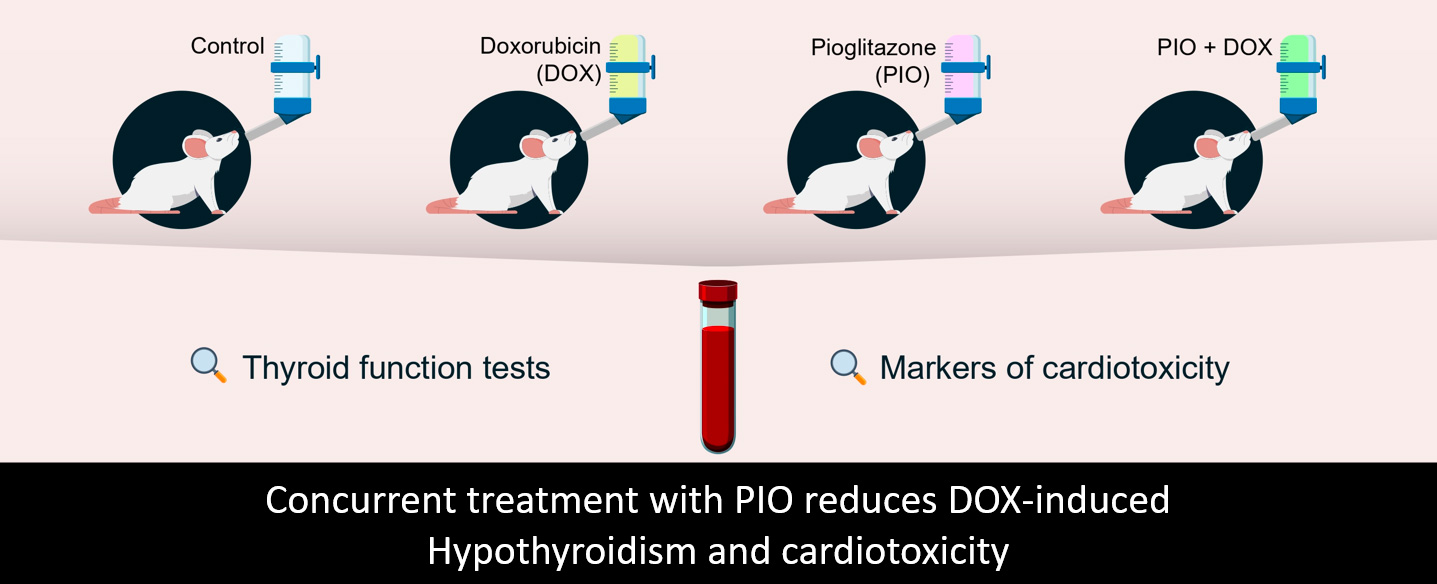
OBJECTIVE: The anticancer drug doxorubicin (DOX) is effective but is associated with complications such as hypothyroidism and cardiotoxicity. Pioglitazone (PIO), which is used to treat diabetes mellitus, has shown potential for treating hypothyroidism and cardiac dysfunction. Therefore, this study explores whether PIO can also ameliorate DOX-induced hypothyroidism and cardiotoxicity.
MATERIALS AND METHODS: Forty female Wistar rats were separated into control and three treated groups (DOX, PIO, and DOX+PIO), and their blood samples were examined for the thyroid hormones, including thyroid-stimulating hormone (TSH), thyroxine in total and free forms (T4 and FT4, respectively), and triiodothyronine in total and free forms (T3 and FT3, respectively), and the cardiotoxicity biomarkers [troponin I, creatine kinase (CK), and creatine kinase-myocardial band (CK-MB)].
RESULTS: The control and PIO groups did not exhibit significant alterations in any of the examined hormones and markers. In contrast, in the DOX group, T4, FT4, T3, and FT3 levels decreased significantly, whereas troponin I, CK, and CK-MB levels increased significantly, but no significant changes were detected in TSH levels. PIO co-treatment ameliorated these effects of DOX significantly in FT4, FT3, and troponin I.
CONCLUSIONS: PIO may provide protection against hypothyroidism and cardiotoxicity caused by DOX treatment, by significant reversal of FT4, FT3, and troponin I levels.
Graphical Abstract

This work is licensed under a Creative Commons Attribution-NonCommercial-NoDerivatives 4.0 International License
To cite this article
A.H. Alhowail
Pioglitazone ameliorates doxorubicin-induced hypothyroidism and cardiotoxicity in rat models
Eur Rev Med Pharmacol Sci
Year: 2023
Vol. 27 - N. 19
Pages: 9388-9395
DOI: 10.26355/eurrev_202310_33966
Publication History
Published online: 13 Oct 2023