
Narrative and arts-based interventions in oncology supportive care: a narrative review of evidence and implications for bridging the distress screening–response gap
S. Cafarotti, P. Perretta, D. Salafia Thoracic Surgery Department, San Giovanni Hospital, EOC, Bellinzona, Switzerland. stefano.cafarotti@eoc.ch
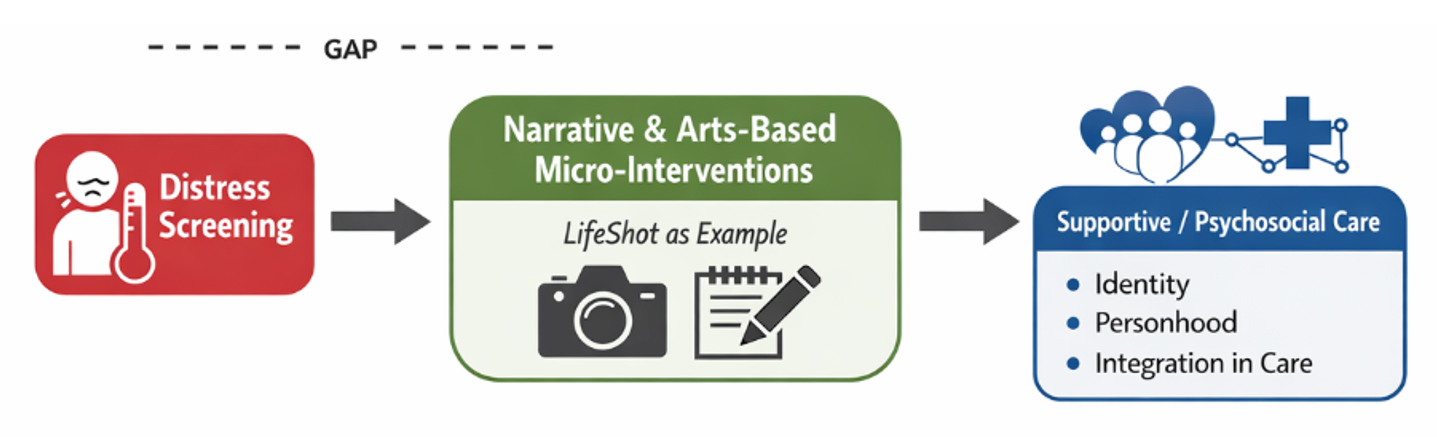
Psychological distress is a core dimension of oncology care and has long been described as the “sixth vital sign”. Although distress screening is widely recommended and increasingly embedded in oncology services, translation of screening results into structured supportive responses remains inconsistent. The aim of the study is to synthesize the literature on narrative and arts-based interventions in adult oncology supportive care and to examine how implementation science can clarify the persistent gap between distress screening and timely supportive action. This manuscript was developed as a targeted narrative review. PubMed and Scopus were searched for systematic reviews, meta-analyses, landmark randomized trials, and implementation science papers relevant to distress screening, narrative medicine, art therapy, creative arts therapy, music interventions, dignity therapy, meaning-centered psychotherapy, and participatory visual methods in oncology. Priority was given to high-quality secondary evidence, seminal conceptual papers, and practice guidelines. Across visual art therapy, creative arts therapy, music interventions, dignity therapy, meaning-centered psychotherapy, and participatory visual approaches, the literature generally shows modest but consistent improvements in anxiety, emotional well-being, quality of life, existential outcomes, and patient experience. However, the same literature repeatedly reveals structural limitations: specialist dependency, multi-session intensity, heterogeneous outcome measurement, short follow-up, and sparse reporting of adoption, fidelity, penetration, cost, and sustainability. These constraints help explain why many psychosocial and arts-based interventions remain peripheral to routine oncology pathways despite favorable therapeutic signals. The central challenge in supportive oncology is no longer only whether distress can be detected, but whether detected distress is followed by a visible, scalable, and person-centered response. The literature supports renewed attention to brief, identity-centered conceptual models that can complement specialist psycho-oncology services and strengthen the connection between screening and supportive care within multidisciplinary cancer systems.
Graphical Abstract

This work is licensed under a Creative Commons Attribution-NonCommercial-ShareAlike 4.0 International License
To cite this article
S. Cafarotti, P. Perretta, D. Salafia
Narrative and arts-based interventions in oncology supportive care: a narrative review of evidence and implications for bridging the distress screening–response gap
Eur Rev Med Pharmacol Sci
Year: 2026
Vol. 30 - N. 4
Pages: 133-142
DOI: 10.26355/eurrev_202604_37751
Publication History
Submission date: 17 Feb 2026
Revised on: 05 Mar 2026
Accepted on: 30 Mar 2026
Published online: 30 Apr 2026