
Association between questionnaire-estimated water intake and urinary biomarkers in older Japanese adults: the KOBE study
J. Ikeguchi, A. Hirata, K. Mizuma, Y. Nakamura, H. Watanabe, N. Murayama, H. Ueshima, H. Tamura, T. Okamura Research Institute, Suntory Global Innovation Center Limited, 8-1-1 Seikadai, Seika-cho, Soraku-gun, Kyoto, Japan. junki_ikeguchi@suntory.co.jp
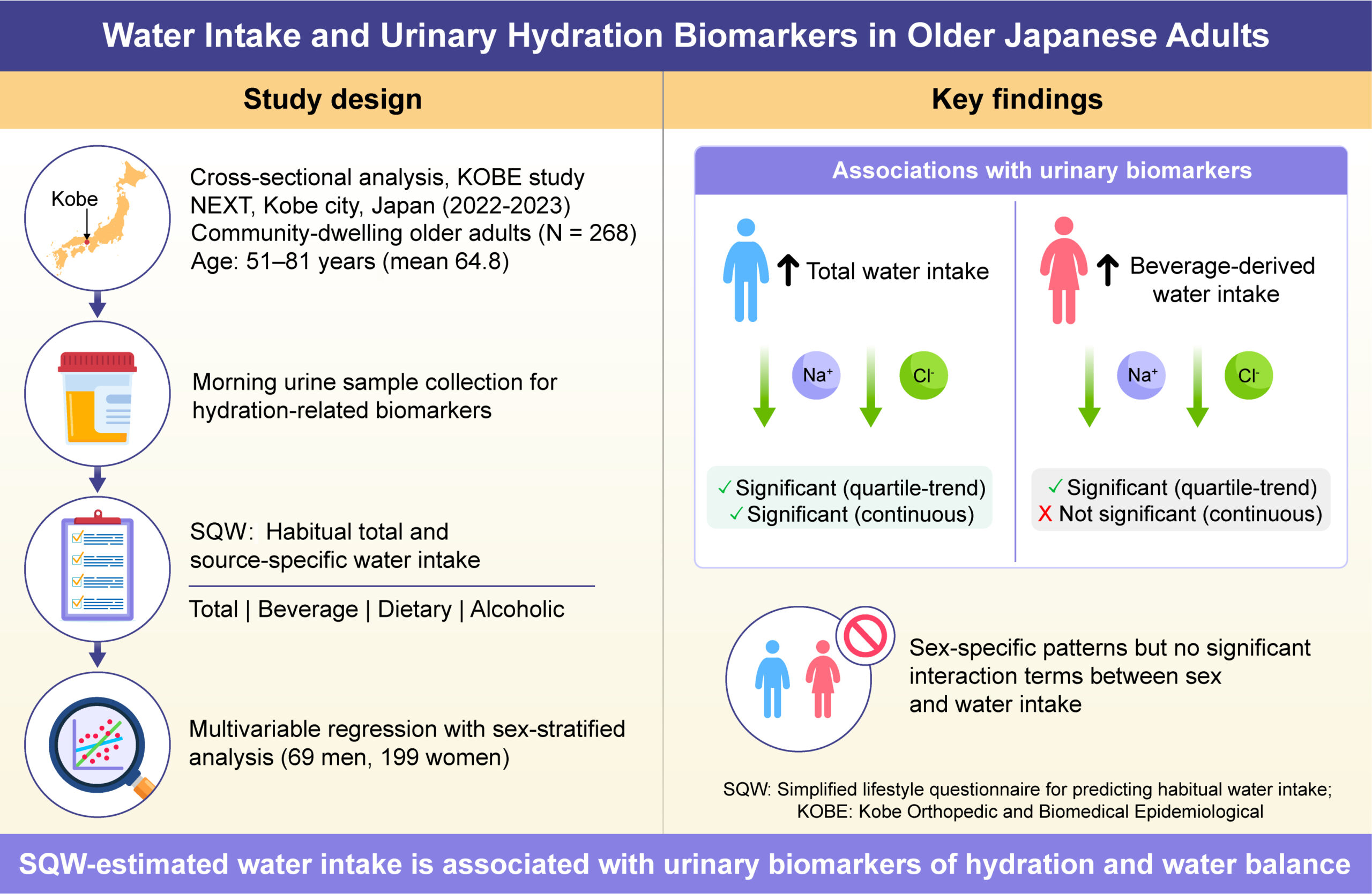
OBJECTIVE: Accurate estimation of habitual water intake is crucial for epidemiological studies of water balance among older adults; however, reliable assessment methods for large-scale research remain limited. This study aimed to investigate the association between habitual water intake, as estimated by a “simplified lifestyle questionnaire for predicting habitual water intake” (SQW), and urinary biomarkers related to hydration and water balance in community-dwelling older adults.
MATERIALS AND METHODS: A cross-sectional analysis was conducted on 268 participants enrolled in the 2022–2023 KOBE Study NEXT survey. Habitual total water intake and source-specific water intake were estimated using the SQW.
Early-morning spot urine samples collected after an overnight fast were used to measure urinary osmolality and electrolyte (sodium, potassium, and chloride) concentrations. The association between estimated water intake (analyzed as a continuous variable and by quartiles) and urinary biomarkers was examined using multivariable linear regression models after adjusting for age, sex, body mass index, smoking status, and alcohol consumption. Analyses were performed separately for men and women, and the sex–intake interaction term was tested.
RESULTS: In men, higher total water intake was significantly associated with lower urinary sodium and chloride concentrations, but not with urinary osmolality. In women, higher beverage-derived water intake was associated with lower urinary osmolality and lower urinary sodium and chloride concentrations in quartile-based trend analyses, whereas continuous analyses showed similar but non-significant trends.
Dietary water intake and alcoholic beverage-derived water intake showed no significant association with urinary biomarkers in either sex. The sex–intake interaction term was not statistically significant.
CONCLUSIONS: Water intake estimated by the SQW was associated with urinary biomarkers related to hydration and water balance in older Japanese adults, with patterns varying according to water-intake source. These findings suggest that the SQW may serve as a practical tool for assessing habitual water intake in epidemiological and public health settings. Future longitudinal studies should investigate causality and clinical relevance.
Graphical Abstract

This work is licensed under a Creative Commons Attribution-NonCommercial-ShareAlike 4.0 International License
To cite this article
J. Ikeguchi, A. Hirata, K. Mizuma, Y. Nakamura, H. Watanabe, N. Murayama, H. Ueshima, H. Tamura, T. Okamura
Association between questionnaire-estimated water intake and urinary biomarkers in older Japanese adults: the KOBE study
Eur Rev Med Pharmacol Sci
Year: 2026
Vol. 30 - N. 9
Pages: 328-338
DOI: 10.26355/eurrev_202609_37971
Publication History
Submission date: 10 May 2026
Revised on: 19 Jun 2026
Accepted on: 15 Sep 2026
Published online: 30 Sep 2026